

Newcastle upon Tyne is a loyal and loving city. The football club is its beating heart, and it cherishes its heroes like few others. From Hughie Gallacher to Jackie Milburn, Bob Moncur to Malcolm Macdonald, Peter Beardsley to Andy Cole, Alan Shearer to Sir Bobby Robson, and Eddie Howe to Bruno Guimarães — all have risen to almost God-like worship on Tyneside.
Perhaps rising to the top, however, is Kevin Keegan, a man so incredibly revered by the people of Newcastle during his three spells of association with the club. His understanding of what Newcastle United could, and indeed should, be undoubtedly made the club what it is today.
As a result, news of his death on Monday, at the age of 75 from cancer, has seen an outpouring of grief so intense that, less than 24 hours later, the space outside the south west corner of St James’ Park has become awash with flowers, shirts, scarves, and bottles of Newcastle Brown Ale. Tears have been shed and prayers have been offered for the one known in these parts as ‘the Messiah’.
Leading the tributes late on Tuesday afternoon was United’s current head coach Eddie Howe, along with club staff and dignitaries. Howe’s face was one of clear sadness and sorrow. Upon his arrival to Newcastle in 2021, he spoke with Keegan about the task that he was undertaking, with the club, at that point, sat second bottom of the Premier League table.
Nearly five years later, Newcastle have twice qualified for the Champions League and ended the long, long wait for major silverware — the one thing Keegan was unable to do during his time in charge. Of course, that was not for the want of trying, and indeed it is because of that effort, and that understanding that Keegan brought to Newcastle, that he is so loved.
As a player, Keegan joined Newcastle from Southampton in 1982, with the Magpies in the Second Division — quite the move for someone who had been crowned Ballon d’Or winner for two consecutive years in 1979 and 1980 whilst at Hamburg. By 1984, Keegan and Newcastle had achieved promotion, with the mercurial number 7 then departing St James’ Park in a helicopter following a testimonial match against Liverpool.
In 1992, he returned to Newcastle with the club on the brink of not only relegation to the Third Division but financial disaster too. Such was his belief in the club and the city, however, that just four years later Newcastle came within a whisker of winning the Premier League.
Such was Newcastle’s points lead over Manchester United in January of the 1995/96 season that you’d be forgiven for thinking that many on Tyneside would see Keegan’s failure to see his side over the line as a calamity that would be better off being forgotten. But no. Not with Keegan. Not when television cameras pictured him slumped over the advertising hoardings as Newcastle lost 4–3 at Anfield in the last minute, and certainly not when, with just two games to go, Keegan delivered his famous “I would love it” monologue/rant live to the nation.
Who in black and white could not love a man who showed that level of passion, hurt, anger, and despair when representing their football club?
As has been told on countless occasions, Newcastle did miss out on the title, and several months later Keegan was gone, perhaps unhappy with some of the decisions at boardroom level at the club, whilst also feeling that he could take the club no further. Before that, though, came the signing of Alan Shearer and a famous 5–0 win over Manchester United.
Forays with Fulham, England, and Manchester City came and went, before the second coming in 2008. Keegan’s return to Newcastle was met with huge joy, but the happiness would be short-lived. A fallout with the then owner Mike Ashley and his aides led to Keegan’s resignation — a battle which would end up in the courtroom, ending with a victory for Keegan.
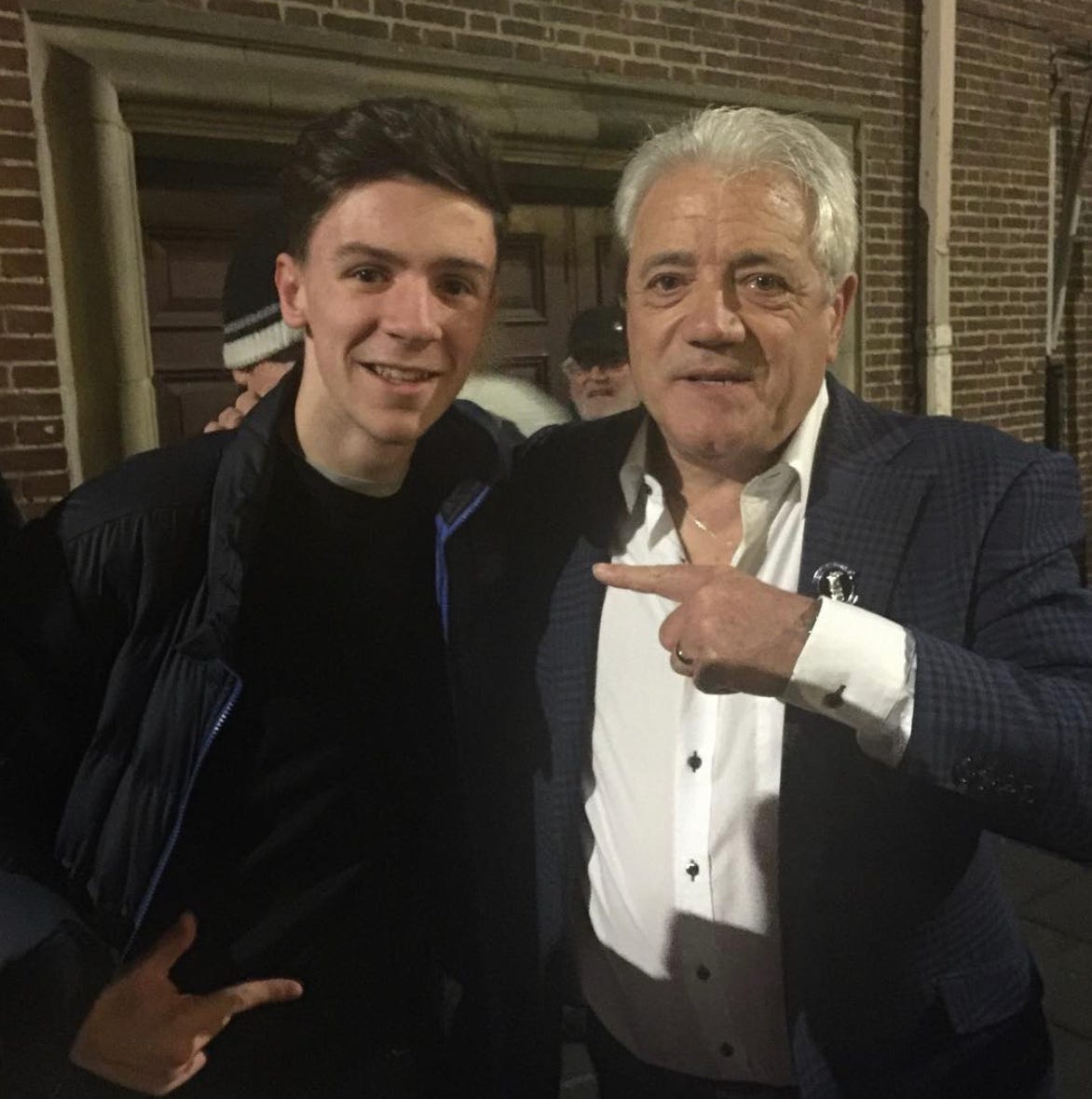
Since then, Keegan’s appearances in the North East have been mostly via talk-in events and dinners, and it was after one of these events that I myself got to meet the man.
Whilst I personally was born after the swashbuckling heyday of Keegan’s ‘Entertainers’, it’s quite difficult, when from the North East, to be oblivious to the stories of what happened and what Keegan did for Newcastle. I do, however, remember his second spell in charge, and even that brief period was enough to render him a hero to the younger version of myself.
They do say, of course, never meet your heroes, but whoever made that statement universally known clearly never met Kevin Keegan. After the particular talk-in I attended in early February 2019 at the City Hall in Newcastle, I eagerly waited at the stage door with my dad, hoping to get a picture with the man himself.
I was not alone in waiting for King Kev. There were several more groups of people who had been at the show, all waiting to meet the Messiah. It’s well documented that Keegan was always generous with his time, and on this occasion he was no different. He went round every person who was there waiting for him, to either chat, take a picture, or sign an autograph.
It couldn’t have been a more enjoyable encounter, and because of that single moment, I was then able to fully understand what Keegan meant to Newcastle, and why now, just over seven years later, the grief and sadness felt by the city is overwhelming.
Newcastle United have announced that, when the time is right, they will mark Keegan’s passing with some form of permanent tribute, be that a statue, a stand named after him, or indeed both. For now, though, the mourning continues.
In the meantime, a new season with new challenges is approaching for the Magpies, and quite fittingly the first match will see Newcastle welcome Liverpool to St James’ Park, another club and city where Keegan is adored. What was going to be a fixture marked by the return of Alexander Isak to Newcastle will instead become an event used to remember a man as great as Kevin Keegan. He will never be forgotten.


